
A central goal of academic cultural heritage institutions, including archives, is to promote curricular use of their collections. An ontological framework that links primary source collections at these institutions to curriculum/instructions use of these collections. The ontological mapping reveals significant gaps in the extent research on the topic.
Ontology
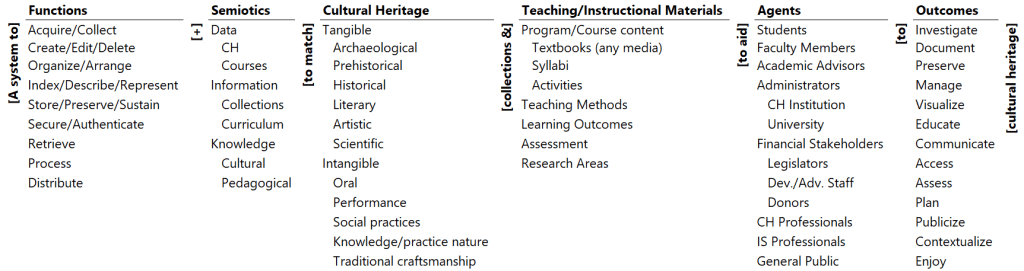
Illustrative Pathways
- A system to acquire/collect data-CH to match tangible-archaeological collections and curriculum syllabi to aid students to investigate cultural heritage.
- A system to index/describe/represent information-curriculum to match intangible-performance collections and research areas to aid faculty members to educate cultural heritage.
- A system to retrieve knowledge-CH to match tangible-artistic collections and curriculum learning outcomes to aid CH professionals to communicate cultural heritage.
Glossary
- Function: The functions of the system.
- Acquire/Collect: To acquire/collect data/information/knowledge about cultural artifacts and curriculum.
- Create/Edit/Delete: To create/edit/delete data/information/knowledge about cultural artifacts and curriculum.
- Organize/Arrange: To organize/arrange data/information/knowledge about cultural artifacts and curriculum.
- Index/Describe: To index/describe data/information/knowledge about cultural artifacts and curriculum.
- Store/Preserve/Sustain: To store/preserve/sustain data/information/knowledge about cultural artifacts and curriculum.
- Secure/Authenticate: To secure/authenticate data/information/knowledge about cultural artifacts and curriculum.
- Retrieve: To retrieve data/information/knowledge about cultural artifacts and curriculum.
- Process: To process data/information/knowledge about cultural artifacts and curriculum.
- Distribute: To distribute data/information/knowledge about cultural artifacts and curriculum.
- Semiotics: Symbolic representations of cultural heritage artifacts and curriculum at different levels of abstraction.
- Data: Measurements and observations, qualitative and quantitative about cultural heritage artifacts and curriculum.
- CH artifacts: Data about CH artifacts.
- Courses: Data about courses in the curriculum.
- Information: Relationships among the data about cultural heritage artifacts and curriculum.
- Collections: Information about collections of CH artifacts.
- Curriculum: Information about the curriculum.
- Knowledge: Interpretations of the relationships among the cultural artifacts and curriculum data.
- Cultural: Knowledge about culture.
- Pedagogical: Knowledge about the pedagogy of the curriculum.
- Data: Measurements and observations, qualitative and quantitative about cultural heritage artifacts and curriculum.
- Cultural Heritage: Artifacts identified with the heritage of a culture.
- Tangible: Tangible cultural heritage artifacts.
- Archaeological: “Products of archaeological excavations (including regular and clandestine) or of archaeological discoveries.” (Source: UNESCO, 1970)
- Prehistorical: Property predating history such as prehistorical tools, structures, paintings, etc.
- Historical: “Property relating to history, including the history of science and technology and military and social history, to the life of national leaders, thinkers, scientists and artist and to events of national importance.” (Source: UNESCO, 1970)
- Literary: “Rare manuscripts and incunabula, old books, documents and publications of special interest (historical, artistic, scientific, literary, etc.) singly or in collections.” (Source: UNESCO, 1970)
- Artistic: “Pictures, paintings and drawings produced entirely by hand on any support and in any material (excluding industrial designs and manufactured articles decorated by hand); original works of statuary art and sculpture in any material; original engravings, prints and lithographs; original artistic assemblages and montages in any material.” (Source: UNESCO, 1970)
- Scientific: Scientific and technological objects, instruments, devices, etc. significant to the advancement of science and technology.
- Intangible: Intangible cultural heritage artifacts.
- Oral: Oral traditions and expressions, including language as a vehicle of the intangible cultural heritage.
- Performance: Performing arts.
- Social: Social practices, rituals and festive events.
- Knowledge & Practice: Knowledge and practices concerning nature and the universe.
- Traditional Craftsmanship: Traditional craftsmanship.
- Tangible: Tangible cultural heritage artifacts.
- Teaching/Instructional Materials: Print or Nonprint Materials Used in Instruction.
- Program and Course Content
- Textbooks (any media): Physical or digital media (including books, audio videos, articles, and maps) embodying the common body of knowledge regarding the subject of the programs or courses.
- Activities: Projects and assignments used to educate as part of the curriculum.
- Syllabi: A description of the structure and content of the courses in the curriculum.
- Teaching methods: The method of teaching the programs or courses.
- Learning Outcomes: Desired outcomes for students at various levels (module, course, program, department, etc.).
- Assessment: The assessment of the teaching and learning at various levels.
- Research Areas: Subject of research by faculty, students, or others.
- Program and Course Content
- Agents: The agents to obtain the various outcomes regarding cultural heritage.
- Students: The students of cultural heritage.
- Faculty Members: The faculty members of cultural heritage.
- Academic Advisors: The academic advisors to students and faculty members.
- Administrators: The administrators of cultural heritage outcomes.
- CH institution: The administrators of cultural heritage institutions (library, archives and museums) and the outcomes.
- University: The university administrators of cultural heritage and the outcomes.
- Financial Stakeholders: the financial stakeholders in the cultural heritage and outcomes.
- Legislators: The legislators involved in funding the cultural heritage and outcomes.
- Dev./Adv. Staff: The development and advancement staff members raising funds for the cultural heritage and outcomes.
- Donors: The donors to programs in cultural heritage and outcomes.
- CH Professionals: the cultural heritage professionals responsible for the outcomes.
- IS Professionals: The information systems professionals responsible for the system and its outcomes.
- General Public: Public at large.
- Outcome: The outcomes of integrating cultural heritage into the curriculum.
- Investigate: To investigate cultural heritage.
- Document: To document cultural heritage.
- Preserve: To preserve cultural heritage.
- Manage: To manage cultural heritage.
- Visualize: To visualize cultural heritage.
- Educate: To educate cultural heritage.
- Communicate: To communicate cultural heritage.
- Access: To access cultural heritage.
- Assess: To assess cultural heritage.
- Plan: To plan cultural heritage.
- Publicize: To publicize cultural heritage.
- Contextualize: To contextualize cultural heritage.
- Enjoy: To enjoy cultural heritage.
Monad Map
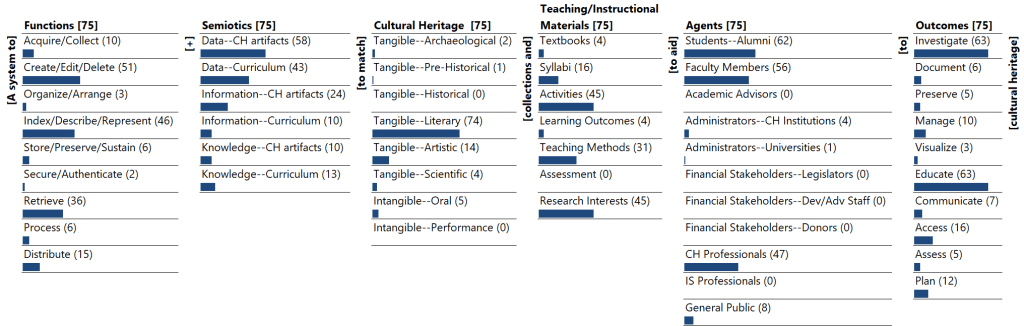
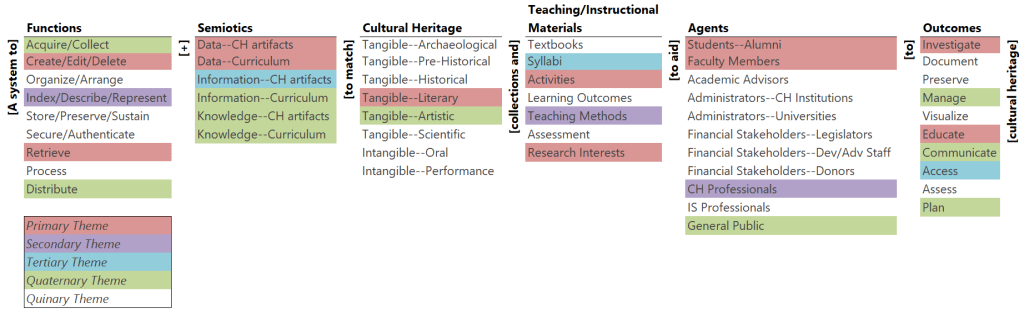
Theme Map
Related Links
Themes in Recent Research on Integrating Primary Source Collections and Instruction
 Our Ontologies
Leave a comment