Sharing river water is a complex problem that involves multiple stakeholders with conflicting interests. Our ontology captures the complex nature of this phenomenon.
Ontology
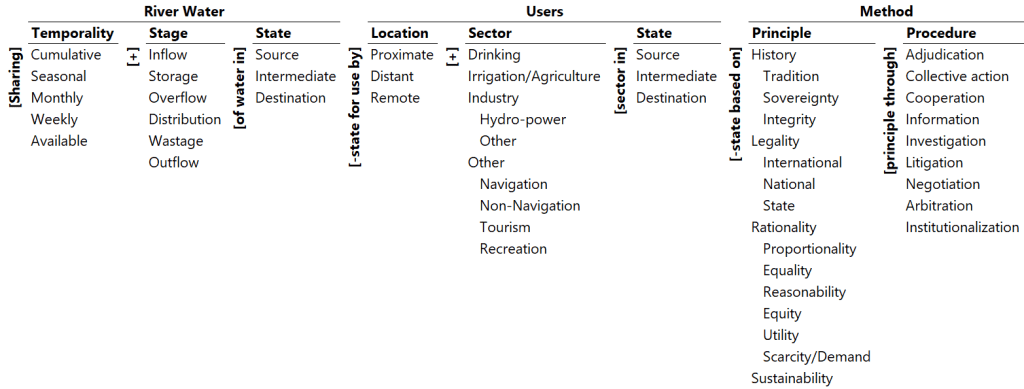
Illustrative Pathways
- Sharing cumulative storage of water in source state for use by drinking in source state based on rationality-proportionality principle through cooperation.
- Sharing seasonal distribution of water in the destination state for the use by distant irrigation/agriculture sector in the destination state based on history-tradition principle through adjudication.
- Sharing monthly distribution of water in destination state for the use by remote drinking sector in destination state based on legality-national principle through litigation.
Glossary
- Temporality: Frequency of river water sharing.
- Cumulative: Sharing of river water cumulatively.
- Seasonal: Sharing of river water seasonally.
- Monthly: Sharing of river water monthly.
- Weekly: Sharing of river water weekly.
- Available: Sharing of available river water.
- Stage: Stages of river water flow cycle in a dam.
- Inflow: Inflow of river water to the natural/artificial storage structure.
- Storage: Storage of river water.
- Overflow: Overflow of river water post full capacity of natural/artificial storage structure.
- Distribution: Distribution of river water from the natural/artificial storage structure.
- Wastage: Wastage of river water from natural/artificial storage structure.
- Outflow: Outflow of river water from natural/artificial storage structure.
- State: Geographical state where the river flows.
- Source: The origin point/state of the river / State where the river originates.
- Intermediate: The flow of a river between its origin and mouth near the confluence.
- Destination: The state where the river water meets the confluence point.
- Location: Location of the population which uses river water.
- Proximate: Population residing closest to the river water.
- Distant: Population at the distant area which is dependent on the river water.
- Remote: Population at the remote area which is dependent on the river water.
- Sector: Different sectors where the river water is used as an input.
- Drinking: River water used for drinking.
- Irrigation/Agriculture: River water used for Irrigation/Agriculture.
- Industries: Industries which are dependent on river water.
- Hydro power: Hydro power industry which is dependent on river water.
- Other: Other industries which are dependent on river water.
- Other: Other sectors which use river water.
- Navigation: River used for navigation.
- Non-Navigation: River water used for non-navigational purpose.
- Tourism: River water used in tourism sector.
- Recreation: River water used for recreational use.
- State: Nation/State where the user of river water belongs.
- Source: User belongs to the geographical state where the river originates.
- Intermediate: User belongs to the geographical state between the origin and mouth of the river near the confluence.
- Destination: User belongs to the geographical state where the river water meets the confluence point.
- Principles: The basic principles of disputes resolution for river-water sharing.
- History: The history of time-line of acts, tribunals, laws and amendments made over time.
- Tradition: Traditional stand taken by the riparian state based on history.
- Sovereignty: Authoritative stand taken by a riparian state based on history.
- Integrity: Integral right of the riparian states over the natural flow of water.
- Legality: Legal discourse/framework followed for the dispute resolution.
- International: International level river-water sharing laws and principles.
- National: National level river-water sharing laws and principles.
- State: state level river water sharing laws and principles.
- Rationality: Principles of rationality used in river water dispute.
- Proportionality: Sharing of river water proportionally based on rational values and goals.
- Equality: Equal sharing of river water.
- Reasonability: Sharing river water based on reasonable requirement by the riparian states.
- Equity: Sharing of river water equitably based on various factors.
- Utility: Sharing of river water based on utilization provided if an act or rule is right.
- Scarcity/Demand: Sharing river water based on scarcity and demand of riparian states.
- Sustainability: Sharing river water based on sustainability of river and environment.
- History: The history of time-line of acts, tribunals, laws and amendments made over time.
- Procedure: The method/ an approach to resolve the disputes regarding river-water sharing.
- Adjudication: The resolution of river water dispute by adjudication.
- Collective action -The resolution of river water dispute by collective action of all the riparian states.
- Cooperation: The resolution of river water dispute by cooperation between riparian states.
- Information: The resolution of river water dispute by using the sources of literary and oral evidences, knowledge systems for river.
- Investigation: The resolution of river water dispute by investigation or systematic examination or research.
- Litigation: The resolution of river water dispute by litigation.
- Negotiation: The resolution of river water dispute by negotiation between riparian states.
- Arbitration: The resolution of river water dispute by arbitration between riparian states.
- Institutionalization: The resolution of river water dispute by an institutionalized authority.
Monad Map
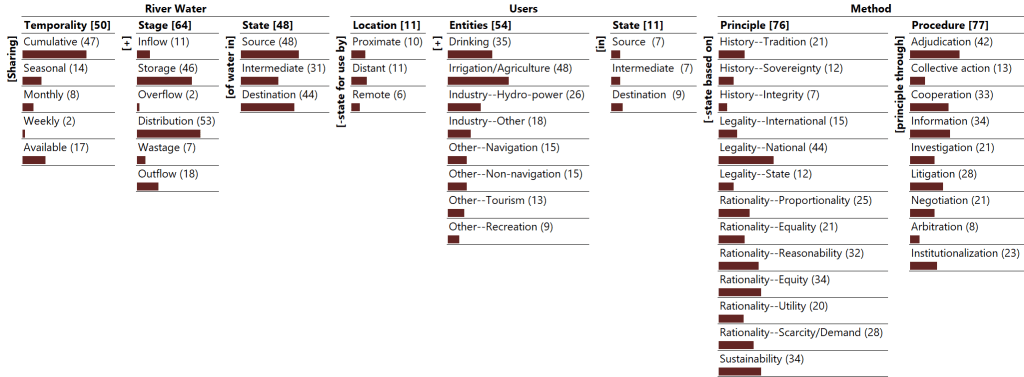
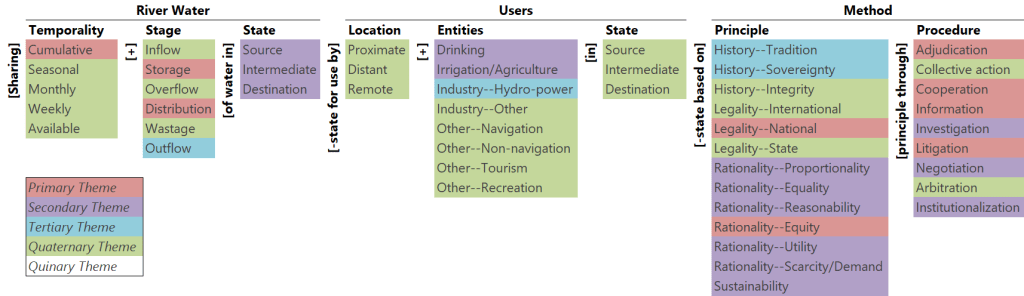
Theme Map
Related Links
Transboundary Sharing of River Water: Informating the Policies
 Our Ontologies
Leave a comment