
What makes a ‘Smart City’, as opposed to a traditional one? We review and synthesize multiple scientific studies and definitions, and present a unified definition of Smart City as an ontology which encapsulates the combinatorial complexity of the concept.
Ontology of Smart City
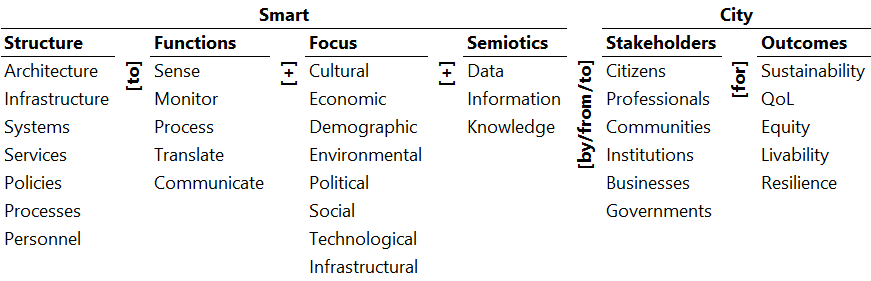
Illustrative Pathways
- Architecture to sense economic information by/from citizens for QoL.
- Systems to process environmental data by governments for livability.
- Policies to communicate technological knowledge by professionals for resilience.
- Processes to translate political information to citizens for sustainability.
Glossary
- Smart: Capable of intelligent sense and response through semiotics.
- Structure: The structure required to manage the semiotics.
- Architecture: The overall architecture to manage the semiotics.
- Infrastructure: The physical and virtual infrastructure to manage the semiotics.
- Systems: The computer, social, and paper-based systems to manage the semiotics.
- Services: The computer, social, and paper-based services to manage the semiotics.
- Policies: The policies on managing the semiotics.
- Processes: The processes to manage the semiotics.
- People: The people responsible for managing the semiotics.
- Functions: The functions required to manage the semiotics.
- Sense: To sense the semiotic elements.
- Monitor: To monitor the semiotic elements over time.
- Process: To process the semiotic elements.
- Translate: To translate the semiotics into action/control.
- Communicate: To communicate the semiotic elements.
- Focus: The focus of intelligent sense and response — smartness.
- Cultural: Cultural dynamics of the city.
- Economic: Economic dynamics of the city.
- Demographic: Demographic dynamics of the city.
- Environmental: Environmental dynamics of the city.
- Political: Political dynamics of the city.
- Social: Social dynamics of the city.
- Technological: Technological dynamics of the city.
- Infrastructural: Infrastructural dynamics of the city.
- Semiotics: The iterative process of generating and applying intelligence.
- Data: The symbolic representation of sensations and measurements.
- Information: The relationship among the data elements.
- Knowledge: The meaning of the relationships among the data elements.
- Structure: The structure required to manage the semiotics.
- City: A city capable of intelligent sense and response
- Stakeholders: Those affecting and affected by the city.
- Citizens: The citizens of the city.
- Professionals: The professionals of the city.
- Communities: The communities of the city.
- Institutions: The institutions of the city.
- Businesses: The businesses of the city.
- Governments: Federal, State, and Local governments.
- Outcomes: The desired outcomes of a smart city.
- Sustainability: Sustainability of the city.
- QoL: Quality of life of the stakeholders.
- Equity: Equity among the citizens of the city.
- Livability: The livability of the city.
- Resilience: The ability of the city to resile.
- Stakeholders: Those affecting and affected by the city.
Monad Map

Theme Map

 Our Ontologies
Leave a comment