
Managing information is central to a smart city’s resiliency. The ontological framework reveals pathways to managing information in smart cities dealing with threats such as Ebola epidemic.
Ontology
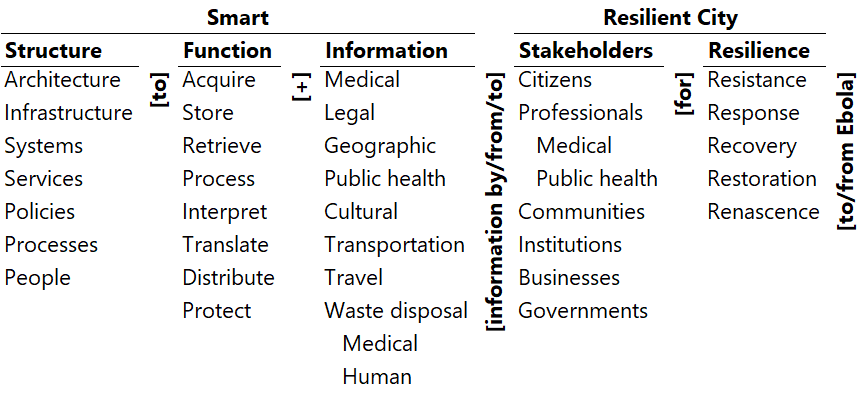
Illustrative Pathways
- Architecture to acquire medical information by/from citizens for resistance to Ebola.
- Systems to process transportation information by communities for response to Ebola.
- Policies to distribute waste disposal information by professionals public health for recovery from Ebola.
- Processes to interpret travel information to citizens for renascence from Ebola.
Glossary
- Smart: Capable of intelligent sense and resilience through management of information.
- Structure: The structural elements required to manage information to sense and resile intelligently.
- Architecture: The architecture to manage information by/from/to stakeholders.
- Infrastructure: The physical and virtual infrastructure to manage information by/from/to stakeholders.
- Systems: The computer, social, and paper-based systems to manage information by/from/to stakeholders.
- Services: The computer, social, and paper-based services to manage information by/from/to stakeholders.
- Policies: The policies of stakeholders on managing information by/from/to stakeholders.
- Processes: The stakeholder processes to manage information by/from/to stakeholders.
- People: The people responsible for managing information by/from/to stakeholders.
- Function: The functional elements required to manage information to sense and resile intelligently.
- Acquire: The capability to acquire information by/from stakeholders.
- Store: The capability to store information by/from stakeholders.
- Retrieve: The capability to retrieve information by/from stakeholders.
- Process: The capability to process information by/from/to stakeholders.
- Interpret: The capability to interpret information by/from/to stakeholders.
- Translate: The capability to translate information by/from/to stakeholders.
- Distribute: The capability to distribute information by/from/to stakeholders.
- Protect: The capability to protect by/from stakeholders.
- Information: The information required by/from/to stakeholders to sense and resile intelligently.
- Medical: Medical information for stakeholders’ resilience.
- Legal: Legal information for stakeholders’ resilience.
- Geographic: Geographic information for stakeholders’ resilience.
- Public health: Public health information for stakeholders’ resilience.
- Cultural: Cultural information for stakeholders’ resilience.
- Transportation: Transportation information for stakeholders’ resilience.
- Travel: Travel information for stakeholders’ resilience.
- Waste disposal: Waste disposal information for stakeholders’ resilience.
- Medical: Medical waste disposal information.
- Human: Human waste disposal information.
- Structure: The structural elements required to manage information to sense and resile intelligently.
- Resilient City: A city capable of rebounding quickly through its sense and resilience.
- Stakeholders: Those affecting and affected by Ebola.
- Citizens: The citizens of the city.
- Professionals: The professionals of the city.
- Medical: The medical professionals of the city.
- Public health: The public health professionals of the city.
- Communities: The communities of the city.
- Institutions: The institutions of the city.
- Businesses: The businesses of the city.
- Governments: Federal, State, and Local governments.
- Resilience: The stages of resilience of the city.
- Resistance: Resistance of the city to Ebola.
- Response: Response of the city to Ebola.
- Recovery: Recovery of the city from Ebola.
- Restoration: Restoration of the city after Ebola.
- Stakeholders: Those affecting and affected by Ebola.
- Renascence: Renascence of the city after Ebola.
Related Links
Managing a Smart City’s Resilience to Ebola: An Ontological Framework
 Our Ontologies
Leave a comment